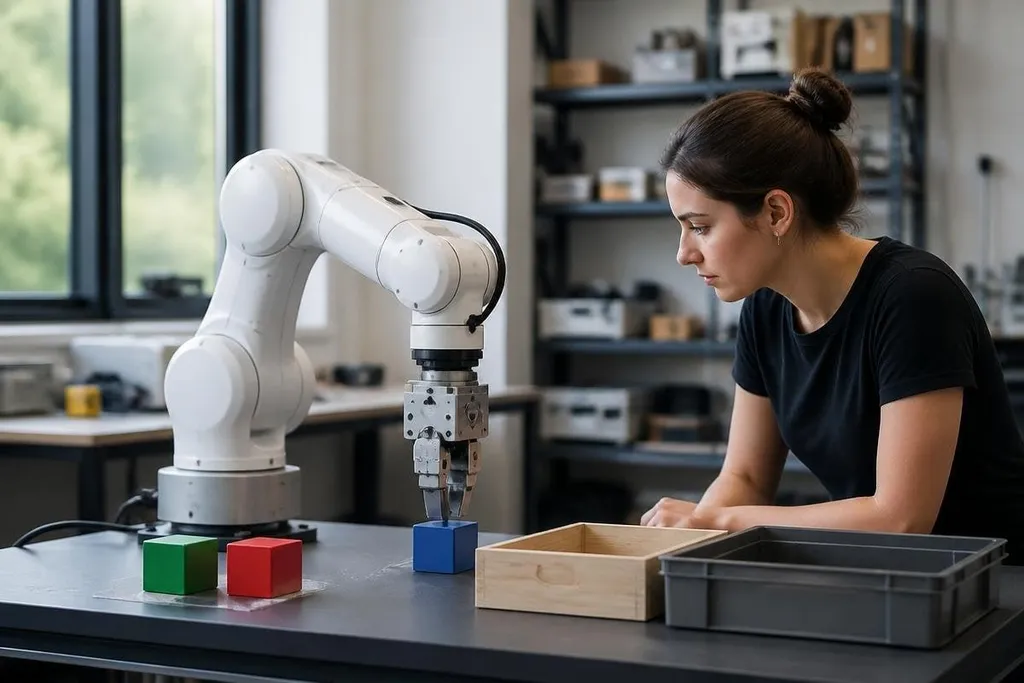
A robot can learn a task through trial and error, simulation, or feedback from sensors instead of copying a person. That removes the need for a human to show every movement, but it does not remove the need for a clear goal, safe limits, and a way to judge results.
- Trial-and-error learning lets a robot test actions and keep the ones that improve its score.
- Simulation gives a robot practice before its motors, gripper, or wheels touch the real world.
- Human input may still define the task, set safety limits, or correct bad behavior.
What learning without demonstrations means
A human demonstration gives a robot an example of the task. The robot watches the action, records the motion, and tries to repeat it. This approach can work well when the task has a clear sequence, such as moving an object from one marked place to another.
The system can also start with no example. In reinforcement learning, it tries an action and receives a reward or penalty based on the result. Picking up an object may raise the score. Dropping it may lower the score. Over many attempts, the control system changes its actions to get better results.
That sounds close to how a person learns, but the comparison has limits. Its reward rule needs to be written or measured, and a poor rule can produce the wrong behavior. If the system rewards speed but ignores damage, it may move too fast for the parts it handles.
The robot still needs a teacher
Removing demonstrations does not remove human choices. People still decide what counts as success, what the robot may touch, how much force it can apply, and when it must stop.
Sensors supply the feedback. Cameras can report where an object is. Force sensors can show that a gripper is pressing too hard. Joint sensors can report the arm's position. The robot uses those signals to compare its current result with the target.
Simulation can reduce the cost of early practice. A virtual robot can repeat a motion many times without wearing out a motor or breaking a part.
The control system then has to transfer that learned behavior to physical hardware, where lighting, surface texture, cable drag, and imperfect calibration can change the result.
This transfer is one of the main limits. A motion that works in a clean virtual room may fail when the real object is heavier, the floor is uneven, or the camera sees glare. The robot needs enough sensor feedback to correct its movement instead of repeating the same error.
Where this approach fits
Learning without demonstrations makes more sense when the robot can test actions safely and measure the result. It fits tasks with clear goals, repeatable settings, and a low cost for failure.
It becomes harder when the task depends on judgment that is difficult to score. Sorting objects by appearance, handling fragile goods, or working near people can require rules that cover safety and quality at the same time.
A reward function can come from a person even when no person moves the robot during training. Robot 24 gives you a place to compare that claim with the named machine, training setup, and test result. The distinction matters because “no demonstrations” can still mean human-designed rules.
I'd be cautious about any claim that a robot learned a useful task with no human input at all. A person usually chose the reward, the training setting, the safety limits, or the test that judged success.
A practical test for learning claims
Before treating a result as proof, check the details that show what the robot actually learned:
- Task definition: Does the report state the goal in a way another team could test?
- Training setting: Did the robot learn in simulation, in a lab, or during normal work?
- Human input: Who set the reward, safety limits, object list, and failure rules?
- Transfer result: Did the same control system work on physical hardware?
- Failure rate: How often did the robot drop, collide, stop, or need help?
The useful question is not just whether a robot learned without demonstrations. Ask how much human design sat around that learning, and how well the result held up outside its training setting. Until those details are reported, “learned on its own” describes a method, not a finished capability.